
9 Signs Your HVAC Airflow Is Poor
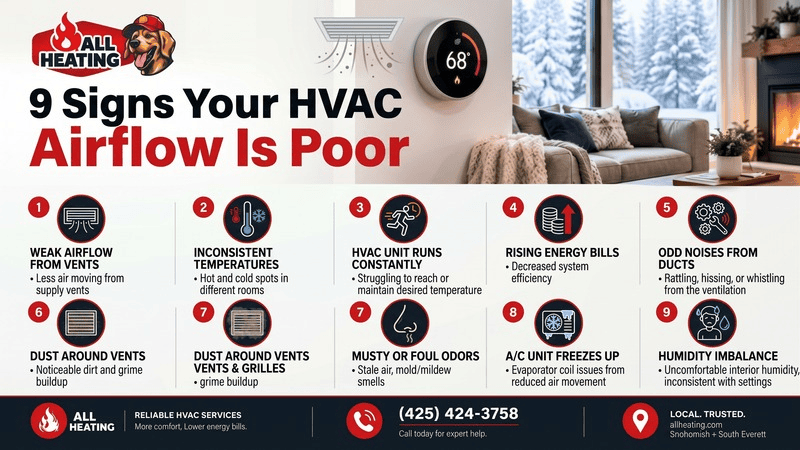
Common signs of poor HVAC airflow include weak air coming from vents, rooms that stay warmer or cooler than others, longer HVAC run times, unusual system noises, and reduced heating or cooling performance. Dirty filters, blocked vents, damaged ductwork, blower problems, and airflow restrictions can all contribute to poor performance. Start with simple checks such as the filter and vents, but persistent HVAC airflow problems should be evaluated by a professional.
Your HVAC system can be running without actually moving enough air through your home.
You may hear the furnace or AC operating, but the rooms don’t feel comfortable. One bedroom may stay warm while another becomes too cold. Air coming from some vents may also feel noticeably weaker than usual.
These are often signs that something is affecting the system’s airflow.
Good airflow is important because your HVAC system depends on moving conditioned air through the home and returning indoor air to the equipment. When that process is restricted, heating and cooling performance can suffer.
Understanding the warning signs can help you determine whether the problem is something simple, such as a dirty filter, or something that requires professional HVAC repair.
Signs Your HVAC System Has Poor Airflow
Airflow problems don’t always appear as an obvious system failure.
Your HVAC equipment may continue turning on and off while gradually providing less air than it normally does.
Here are some of the most common warning signs to watch for.
Weak Air From Vents
One of the clearest signs of poor HVAC airflow is noticeably weak air coming from your supply vents.
If you normally feel a strong stream of heated or cooled air but the airflow has become faint, something may be restricting the system.
Possible causes include:
- A clogged air filter
- Blocked vents
- Damaged ductwork
- Blower problems
- Restricted return air
- Internal HVAC component issues
Before assuming the equipment has failed, check that the vents are open and that furniture or other objects aren’t blocking them.
If multiple vents have weak airflow, the problem may be further upstream in the HVAC system.
Uneven Room Temperatures
Another common sign is a noticeable temperature difference between rooms.
For example, the living room may feel comfortable while a bedroom remains too warm. Another room may receive plenty of conditioned air while a distant room barely receives any.
Uneven temperatures can happen for several reasons, including:
- Poor duct design
- Duct leaks
- Blocked vents
- Inadequate return airflow
- Insulation problems
- Equipment sizing issues
One room having less airflow doesn’t necessarily mean the HVAC unit itself is failing.
The distribution system needs to be evaluated as well.
What Causes Weak HVAC Airflow?
There are many potential causes of poor HVAC airflow.
Some are simple maintenance issues that homeowners can check themselves. Others require equipment testing or professional diagnosis.
Dirty Air Filters
A dirty filter is one of the first things to check when airflow suddenly becomes weaker.
As dust and particles collect on the filter, the restriction can increase.
A heavily loaded filter can make it harder for air to pass through the system.
This can result in:
- Weak airflow
- Longer system run times
- Reduced comfort
- Increased strain on the HVAC system
Check your filter regularly and replace it according to the filter and equipment manufacturer’s recommendations.
Avoid assuming that every home needs the same replacement schedule. Filter loading varies based on the home, occupants, pets, construction, and HVAC usage.
Blocked or Damaged Ductwork
Your ductwork is responsible for delivering conditioned air from the HVAC equipment to different areas of your home.
If a duct is crushed, disconnected, blocked, or leaking, airflow can be reduced.
Potential ductwork problems include:
- Loose connections
- Damaged flexible ducts
- Leaking seams
- Poor insulation
- Restricted duct sections
- Improper duct sizing
A duct problem can also explain why one room receives less air than another.
If airflow is consistently weak in a particular area, having the ductwork inspected can help identify whether the problem is related to distribution.
Other Possible Causes of Poor HVAC Airflow
Not every airflow problem comes from a filter or duct.
If those areas appear normal, the HVAC equipment itself may need to be checked.
Potential causes can include:
Blower Problems
The blower moves air through the HVAC system.
If the blower motor, wheel, or related components aren’t operating correctly, airflow can decrease.
Blocked Return Vents
Your HVAC system needs a suitable return-air path.
If return vents are blocked by furniture or other objects, the system may not receive enough air to circulate properly.
Dirty Internal Components
Dust and debris can accumulate on certain HVAC components over time.
Depending on the equipment, this may affect airflow and overall performance.
Closed or Blocked Supply Vents
Check that supply registers are open and aren’t covered by furniture, rugs, curtains, or other objects.
If only one or two rooms have an airflow issue, this is a good place to start.
How Poor Airflow Affects Your HVAC System
Airflow problems don’t only affect comfort.
If the system repeatedly operates under restricted airflow conditions, performance and equipment operation can also be affected.
Higher Energy Consumption
When your HVAC system isn’t moving air effectively, it may need to operate for longer periods to reach the thermostat setting.
Longer run times can increase energy consumption.
However, poor airflow isn’t the only reason an HVAC system may run longer.
Outdoor temperature, insulation, equipment capacity, thermostat settings, and home size can also affect operating time.
That’s why it’s important to identify the actual cause rather than assuming airflow is the only issue.
Increased HVAC Wear
Your heating and cooling equipment contains components that operate repeatedly throughout the year.
Persistent airflow restrictions can place additional stress on the system.
Depending on the type of problem, this may contribute to issues involving:
- Blower components
- Heat exchangers
- Cooling coils
- Motors
- Other system components
Addressing airflow problems early can help prevent a small restriction from developing into a larger performance problem.
How to Improve HVAC Airflow
Improving airflow starts with simple checks.
If those don’t solve the problem, a professional inspection can determine where the restriction is occurring.
Replace the Air Filter
Start by checking your HVAC filter.
If it is visibly dirty or loaded with dust, replace it with a compatible filter.
Make sure the replacement filter is the correct size and type for your equipment.
Don’t assume that a higher filtration rating is always better.
The filter should provide the desired level of filtration without creating airflow problems for equipment that isn’t designed for excessive resistance.
Check Your Vents and Returns
Walk through the home and check your supply and return vents.
Make sure:
- Supply vents are open.
- Return vents aren’t blocked.
- Furniture isn’t covering registers.
- Curtains aren’t restricting airflow.
- Rugs aren’t covering floor registers.
This simple check can sometimes reveal an airflow problem that doesn’t require an HVAC repair.
Schedule Professional HVAC Inspection
If the problem continues after checking the filter and vents, it’s time to consider a professional inspection.
An HVAC technician can evaluate the complete airflow path rather than focusing only on the equipment.
Depending on the symptoms, the inspection may include:
- Filter condition
- Supply airflow
- Return airflow
- Blower operation
- Ductwork
- System controls
- Indoor coils
- Equipment performance
Professional HVAC upgrades and diagnosis is especially important when airflow suddenly changes or multiple rooms are affected.
Why One Room May Have Less Airflow Than Another
It is common for homeowners to assume that every vent should produce exactly the same amount of air.
That’s not necessarily the case.
Different rooms may have different duct lengths, register sizes, and airflow requirements.
However, a significant difference can indicate a problem.
Possible explanations include:
- A partially blocked duct
- Duct leakage
- Poor duct design
- Closed dampers
- A room addition that wasn’t properly integrated
- Insufficient return air
- Changes made during previous renovations
If one room has always been warmer or cooler, the issue may be related to the original design.
If the problem appeared recently, a new restriction or equipment issue may be more likely.
When Does Poor Airflow Require HVAC Repair?
Some airflow issues can be handled at home.
For example, replacing a dirty filter or moving furniture away from a vent is straightforward.
Professional HVAC repair or inspection becomes more appropriate when:
- Multiple vents have weak airflow.
- Airflow suddenly becomes much weaker.
- The HVAC system makes unusual noises.
- The system struggles to maintain the thermostat setting.
- One area of the home consistently receives very little air.
- You suspect damaged ductwork.
- The blower isn’t operating correctly.
- Changing the filter doesn’t improve the problem.
Avoid attempting electrical, refrigerant, gas, or internal mechanical repairs yourself.
Poor Airflow Troubleshooting Checklist
| What You Notice | What to Check First |
| Weak airflow from every vent | Filter, return air, blower, ductwork |
| One room has weak airflow | Local ductwork and register |
| Airflow suddenly decreased | Filter and system condition |
| Furnace airflow is weak | Filter, blower, return airflow |
| AC airflow is weak | Filter, blower, coil, ductwork |
| Airflow varies between rooms | Ductwork and distribution |
| HVAC runs for long periods | Airflow, insulation, sizing, system condition |
This checklist can help you decide where to begin, but it doesn’t replace professional diagnosis when the problem persists.
FAQs
What are the signs of poor HVAC airflow?
Common signs include weak air from vents, uneven room temperatures, longer HVAC run times, reduced heating or cooling performance, and noticeable changes in airflow compared with normal operation.
Why is airflow weak from my vents?
Weak airflow can result from a dirty filter, blocked vents, damaged ductwork, restricted return air, blower problems, or other HVAC issues. Check the filter and vents first. If airflow remains weak, professional inspection may be necessary.
Can a dirty filter reduce airflow?
Yes. A heavily loaded filter can restrict the amount of air moving through the HVAC system. Check and replace your filter according to the equipment and filter manufacturer’s recommendations.
Why does one room have less airflow?
A single room with weak airflow may have a ductwork restriction, damaged duct, poor distribution, blocked register, or inadequate airflow design. If the problem has always existed, the home’s original duct design may also be a factor.
How can I improve HVAC airflow?
Start by checking the filter, supply vents, and return vents. Keep registers unobstructed and replace a dirty filter with a compatible one. If the problem continues, have the HVAC system and ductwork professionally inspected.
When does poor airflow require professional repair?
Professional help is recommended when airflow remains weak after basic checks, multiple rooms are affected, the problem appears suddenly, the system makes unusual noises, or you suspect a blower, ductwork, electrical, or internal equipment problem.
Get Your HVAC Airflow Back on Track
Good airflow is an important part of comfortable and reliable heating and cooling.
If you notice weak airflow from vents, uneven room temperatures, or a sudden change in how your system moves air, start with the simple checks. A dirty filter or blocked register may be all that’s causing the problem.
When those checks don’t solve the issue, don’t ignore it. Persistent HVAC airflow problems can point to ductwork, blower, return-air, or equipment issues that need professional attention.
If you’re experiencing signs of poor HVAC airflow, All Heating Services can inspect your system and help identify the cause. Contact us for professional HVAC service and airflow troubleshooting in the Snohomish and Everett area.
