
What Size Heat Pump Do I Need for My Home?
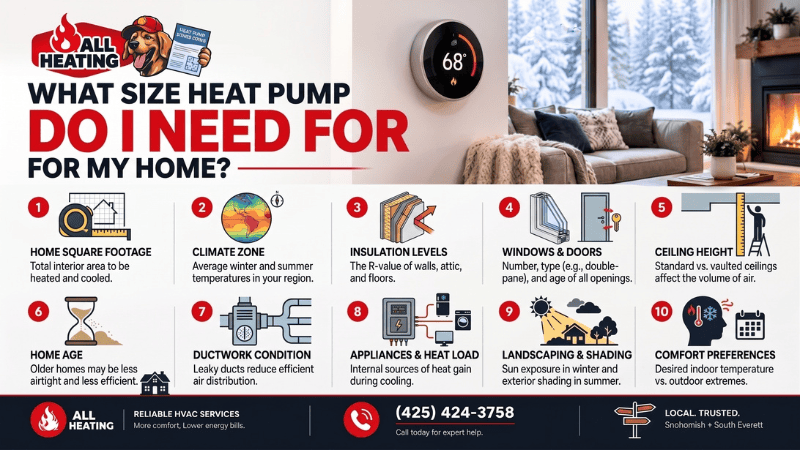
The right heat pump size depends on more than your home’s square footage. A proper heat pump sizing calculation considers the home’s floor area, insulation, windows, ceiling height, layout, local weather, and heating and cooling requirements. A system that is too large may cycle more often, while one that is too small may struggle to maintain comfortable temperatures. The most reliable way to determine the right size heat pump is through a professional heating and cooling load calculation rather than relying only on a basic BTU calculator.
Choosing a heat pump is a significant decision, but selecting the right size is just as important as choosing the equipment itself.
A heat pump that is correctly matched to your home can provide more consistent temperatures and operate more effectively. Choosing based only on square footage, however, can lead to an inaccurate result.
You may have seen online tools described as a heat pump size calculator or heat pump BTU calculator. These can provide a rough starting point, but they cannot account for every characteristic of your home.
This guide explains how professional sizing works, what affects the calculation, and what can happen when a heat pump is too large or too small.
Why Does Heat Pump Size Matter?
Heat pump size determines how much heating and cooling capacity the system can provide.
Unlike choosing a household appliance based simply on physical dimensions, HVAC sizing is about matching the equipment’s capacity to the home’s actual heating and cooling load.
Choosing the correct capacity can help your system operate closer to the conditions it was designed for.
Energy Efficiency and Operating Costs
An improperly sized heat pump can affect how efficiently the system operates.
An oversized system may reach the thermostat setting quickly and shut off before completing a longer operating cycle. An undersized system may need to operate for extended periods to keep up with the home’s heating demand.
Neither situation is ideal.
Sizing is therefore only one part of getting good performance. Correct installation and system setup matter too.
Consistent Heating and Cooling
A properly sized heat pump should be capable of meeting the home’s heating and cooling requirements without being dramatically oversized or undersized.
Correct sizing can contribute to:
- More consistent indoor temperatures
- Better system operation
- Appropriate heating capacity
- Effective cooling during warmer weather
- Better comfort across different rooms
If some areas of your home are consistently uncomfortable, however, heat pump size may not be the only issue. Insulation, windows, ductwork, airflow, and the home’s layout can all influence temperature differences.
How Is a Heat Pump Properly Sized?
Professional heat pump sizing involves more than measuring the home’s floor area.
An HVAC professional evaluates the amount of heating and cooling capacity the home actually requires.
Home Size and BTU Requirements
Square footage is useful information, but it should not be the only measurement used to select a heat pump.
Two homes with the same floor area can have very different heating requirements.
For example, one home might have:
- Excellent insulation
- Modern windows
- Low air leakage
- A compact layout
Another home with the same square footage could have:
- Older windows
- Less insulation
- Higher ceilings
- More air leakage
- Multiple additions
The two homes may therefore require different equipment capacities.
What Does BTU Mean?
BTU stands for British thermal unit and is commonly used to describe heating and cooling capacity.
When people search for a heat pump BTU calculator, they’re usually trying to estimate how many BTUs their home requires.
A basic online calculator may ask for information such as:
- Home square footage
- Number of floors
- Climate
- Insulation
- Window type
However, these estimates should not replace a professional load calculation when you’re preparing for a heat pump installation.
Professional Load Calculations
A professional load calculation provides a much more detailed assessment of your home’s heating and cooling requirements.
For residential HVAC systems, contractors may use recognized industry procedures such as ACCA Manual J to calculate heating and cooling loads.
The Air Conditioning Contractors of America (ACCA) provides information about Manual J residential load calculations and HVAC design practices.
A detailed calculation can account for factors such as:
- Building dimensions
- Insulation levels
- Window characteristics
- Door areas
- Orientation
- Air leakage
- Occupancy
- Local outdoor design conditions
The result gives the contractor a stronger basis for selecting the right size heat pump.
What Factors Affect Heat Pump Sizing?
The heat pump for your home should be selected based on the home’s actual characteristics rather than a generic rule.
Several factors can change the amount of heating or cooling capacity required.
Insulation and Windows
The condition of your home’s insulation can significantly influence heat transfer.
A well-insulated home generally loses less heat during winter than a poorly insulated home.
Windows also matter.
Large windows, older single-pane windows, and windows with less effective insulating properties can increase heat transfer between indoors and outdoors.
During a sizing assessment, a contractor may consider:
- Window area
- Window orientation
- Glass type
- Insulation levels
- Exterior walls
- Attic insulation
- Floor insulation
This is one reason two homes of the same size may require different heat pump capacities.
Home Layout and Climate
Your home’s design also affects the sizing calculation.
Important considerations can include:
- Number of floors
- Ceiling height
- Open or closed floor plans
- Room arrangement
- Finished or unfinished areas
- Additions
- Local outdoor temperatures
Climate is particularly important because a heat pump must be capable of meeting the home’s heating requirements under local winter conditions.
For homeowners in Snohomish and surrounding areas, the contractor should evaluate local design conditions when determining the appropriate system capacity rather than applying a sizing rule from a different region.
Heat Pump Sizing Factors
| Factor | Why It Matters |
| Home size | Establishes the overall area requiring heating and cooling |
| Insulation | Affects how quickly the home gains or loses heat |
| Windows | Influences heat transfer and solar gains |
| Ceiling height | Changes the volume of conditioned space |
| Home layout | Affects how heat moves between spaces |
| Air leakage | Can increase heating and cooling demand |
| Local climate | Determines outdoor design conditions |
| Existing ductwork | Can affect airflow and system performance |
What Happens If a Heat Pump Is the Wrong Size?
Choosing the wrong capacity can create performance problems even when the equipment itself is high quality.
Both oversized and undersized systems can have disadvantages.
Problems With Oversized Heat Pumps
An oversized heat pump has more capacity than the home needs under certain operating conditions.
It may reach the thermostat setting quickly and shut down instead of running through longer, steadier cycles.
Potential problems can include:
- Frequent cycling
- Less consistent comfort
- Increased mechanical starts and stops
- Difficulty maintaining ideal humidity during cooling
- Reduced operating efficiency in some conditions
An oversized system isn’t automatically a bad system. The issue is whether its capacity is appropriate for the home’s actual load.
Modern variable-capacity heat pumps can also adjust their output over a range, which makes equipment selection more nuanced than simply looking at the maximum capacity.
Problems With Undersized Heat Pumps
An undersized heat pump doesn’t have enough capacity to adequately meet the home’s heating or cooling demand under certain conditions.
You may notice:
- Longer operating periods
- Difficulty reaching the thermostat setting
- Reduced comfort during extreme weather
- Increased reliance on supplemental heat
- Greater strain during periods of high demand
Longer operation isn’t necessarily a problem by itself. Heat pumps are designed to run for extended periods under many conditions.
The concern is whether the system can meet the home’s actual load while maintaining acceptable comfort.
Heat Pump Sizing: What Homeowners Should Know
Before purchasing equipment, don’t rely on a simple square-footage estimate alone.
A useful sizing process should answer several questions:
- How much heating capacity does the home require?
- How much cooling capacity does it require?
- What are the home’s insulation levels?
- How efficient are the windows?
- What are the local outdoor design conditions?
- How is the home laid out?
- Does the existing ductwork provide adequate airflow?
- What type of heat pump is being considered?
- How does the system’s capacity change at different outdoor temperatures?
- Is supplemental heat required under certain conditions?
This approach provides a much better foundation for selecting equipment than simply asking, “What size heat pump do I need based on square footage?”
Heat Pump Sizing vs. Square Footage Estimates
| Approach | Accuracy | Best Use |
| Square-footage rule | Low | Very rough estimate |
| Online heat pump calculator | Moderate at best | Initial research |
| Contractor load calculation | Much more detailed | Equipment selection |
| Professional system design | Comprehensive | New heat pump installation |
A calculator can be useful for learning the basics, but it shouldn’t be the final basis for purchasing an expensive HVAC system.
FAQs
What size heat pump do I need for my house?
The required heat pump size depends on your home’s heating and cooling load, not just square footage. Insulation, windows, ceiling height, layout, air leakage, and local climate all influence the required capacity.
How is a heat pump properly sized?
A professional HVAC contractor should perform a heating and cooling load calculation that evaluates the home’s construction, insulation, windows, size, layout, and local climate conditions. The results are then used to select suitable equipment.
Can a heat pump be too big for a house?
Yes. An oversized heat pump may reach the thermostat setting quickly and cycle more frequently. Depending on the equipment and operating conditions, this can affect comfort, efficiency, and humidity control.
What happens if a heat pump is undersized?
An undersized heat pump may have difficulty meeting the home’s heating or cooling demand during periods of high demand. It may operate for extended periods and could require supplemental heating in certain conditions.
How many BTUs do I need for a heat pump?
There is no single BTU requirement based only on home size. The correct capacity should be determined through a detailed load calculation that considers the home’s construction, insulation, windows, layout, and local climate.
Does home insulation affect heat pump sizing?
Yes. Insulation affects how quickly heat moves between your home and the outdoors. A well-insulated home may have a lower heating load than a similar-sized home with significant heat loss.
Choose the Right Heat Pump for Your Home
Finding the answer to “what size heat pump do I need?” requires more than entering your home’s square footage into an online calculator. The right equipment depends on the actual heating and cooling demands of the property.
Insulation, windows, layout, climate, air leakage, and existing HVAC infrastructure can all influence the final selection.
If you’re considering a heat pump installation, avoid choosing equipment based solely on a generic BTU estimate. A professional load calculation can provide a much more reliable basis for selecting the system.
If you need help determining the right size heat pump for your home, All Heating Services can evaluate your home’s heating and cooling requirements and help you choose an appropriately sized system. Contact us to discuss your heat pump installation needs and get started with the right system for your home.
