
What Is the Difference Between an Air Filter and an Air Purifier?
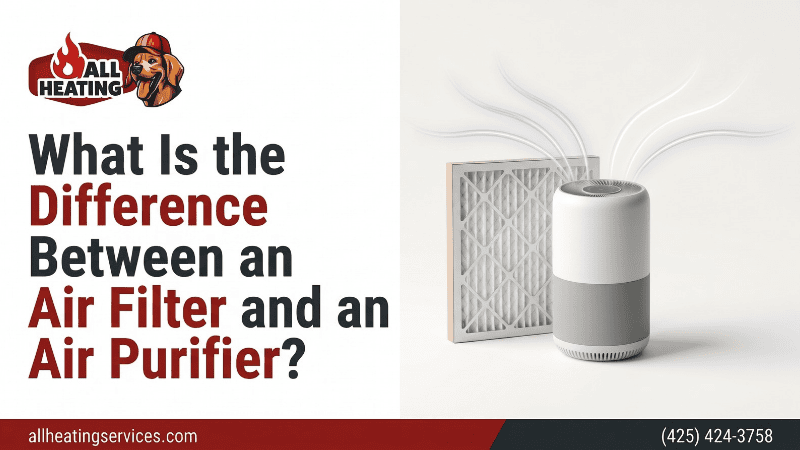
An HVAC air filter captures airborne particles as air moves through the heating and cooling system, helping protect equipment and improve indoor air quality. An air purifier provides additional air cleaning, often using higher-efficiency filtration or other technologies. Many homes can benefit from both, depending on indoor air concerns, HVAC compatibility, and the level of filtration needed.
Your HVAC system and indoor air quality are closely connected, but an air filter and an air purifier do not perform exactly the same job. An HVAC filter is installed within the heating or cooling system and filters air as it circulates. An air purifier is designed to provide additional air cleaning, either in a room or as part of a whole-home system.
Understanding the difference can help you decide whether replacing your existing filter is enough or whether additional air purification makes sense.
How Does an HVAC Air Filter Work?
An HVAC air filter sits in the return-air path of a heating or cooling system. As the blower moves air through the system, the filter captures some of the airborne particles before the air is circulated back through the home.
The filter’s effectiveness depends on factors such as its rating, airflow, size, and how often it is replaced. ASHRAE notes that particle filters capture particles as air passes through fibrous filter media, with performance varying according to particle size and airflow conditions.
Protecting the HVAC System
One of the main purposes of an HVAC air filter is protecting the equipment.
Dust, lint, hair, and other particles can accumulate on components such as the blower and indoor coil if they are allowed to circulate freely. A suitable filter helps reduce the amount of debris reaching these components.
The filter also needs to fit correctly. A poorly fitted or overloaded filter can allow air to bypass the filter or restrict airflow through the system.
Regular replacement is therefore part of normal HVAC maintenance. The right replacement interval depends on the filter, system operation, household conditions, and manufacturer’s recommendations.
Capturing Airborne Particles
An HVAC filter can also contribute to better indoor air quality by capturing airborne particles.
Filter ratings such as MERV help indicate how effectively a filter captures different particle sizes. The EPA’s guidance on home air cleaners and HVAC filters recommends using the highest-rated filter that the HVAC system can accommodate.
However, a higher-rated filter is not automatically better for every system. If the equipment is not designed to handle the additional resistance, airflow can be affected. Filter selection should consider both filtration performance and HVAC compatibility.
How Does an Air Purifier Work?
An air purifier is designed to provide additional air cleaning beyond the basic filtration provided by an HVAC system.
Portable units typically draw room air through a filter and return the cleaned air to the same space. Whole-house or HVAC-integrated systems can be installed within the ductwork or air-handling system to treat air as it circulates.
The type of purifier matters because different technologies target different contaminants.
Additional Air Cleaning
A home air purifier can provide additional particle removal in areas where standard HVAC filtration may not be sufficient.
For example, a portable HEPA air cleaner can continuously clean air in a particular room. A whole house air purifier can provide broader coverage when properly selected and integrated with the HVAC system.
Air purifiers do not eliminate every indoor pollutant, though. The EPA recommends addressing pollution sources and providing adequate ventilation alongside filtration and air cleaning.
This is important because indoor air quality is influenced by more than airborne particles. Cooking, cleaning products, building materials, moisture, outdoor pollution, and other sources can all affect the air inside a home.
Different Purification Technologies
Air purification is not limited to one technology.
Mechanical filters, including HEPA filters, physically capture particles. Some systems also use activated carbon or other media to target certain gaseous pollutants and odors. Other air-cleaning technologies may use electrical or ultraviolet processes.
ASHRAE separates particle filtration from the treatment of gaseous contaminants because they involve different removal methods. This means an air purifier should be selected based on the specific indoor air concern rather than simply choosing the most powerful-sounding technology.
Air Filter vs. Air Purifier: What Is the Difference?
The main difference between an air filter and an air purifier is their purpose, placement, and level of air cleaning.
An HVAC air filter is a component of the heating and cooling system. An air purifier is an additional device or system designed to provide air cleaning.
| Feature | HVAC Air Filter | Air Purifier |
| Main purpose | Filters air moving through the HVAC system | Provides additional air cleaning |
| Typical location | Return-air duct, furnace, or air handler | Room, ductwork, or HVAC system |
| Common target | Airborne particles | Particles and, depending on technology, some gases or other contaminants |
| System role | Protects HVAC equipment and supports filtration | Adds another level of air cleaning |
| Maintenance | Regular filter replacement | Filter replacement, cleaning, or other maintenance depending on technology |
| Whole-home coverage | Possible through central HVAC | Possible with a properly designed whole-house system |
Filtration vs. Air Purification
The terms are sometimes used interchangeably, but they are not always describing the same thing.
Filtration generally refers to removing particles from an airstream using a filter. Air purification is a broader term that can include filtration as well as other methods of removing or treating contaminants.
For example, a standard HVAC filter may capture dust and other particles while an air purification system could combine particle filtration with additional media or technology.
That does not mean every air purifier provides better results than every HVAC filter. Performance depends on the equipment, filter efficiency, airflow, room size, operating time, and the pollutants being targeted.
Different Purposes
An HVAC filter is needed as part of normal system operation. It helps keep the HVAC equipment cleaner while filtering particles from circulating air.
An air purifier is generally added when there is a reason to increase air cleaning in a room or throughout the home.
The CDC’s guidance on improving air cleanliness notes that filtration can be provided through central HVAC systems as well as portable or built-in room air cleaners. It also emphasizes proper filter sizing, fit, and service life.
This makes the decision less about choosing an “air filter or air purifier” and more about determining whether the home’s existing HVAC filtration meets its needs.
Which Option Is Better for Your Home?
There is no single answer to whether an air filter or air purifier is better. The right choice depends on the HVAC system, the home’s layout, the occupants’ needs, and the specific indoor air quality concern.
In many homes, the first step is making sure the existing HVAC filtration is appropriate and maintained correctly.
When a Better Filter Is Enough
A better HVAC filter may be sufficient when the main concern is ordinary airborne dust and particle filtration.
Before upgrading, check the filter size, MERV rating, replacement schedule, and the HVAC manufacturer’s recommendations. A filter that is too restrictive for the system can create airflow problems, so the highest available rating is not necessarily the correct choice.
Regular maintenance also matters. Even a high-efficiency filter will not perform properly if it is dirty, damaged, incorrectly fitted, or left in place beyond its useful service period.
Homes with older ductwork or heating equipment may also have other issues affecting airflow and comfort. For example, common heating problems in older Snohomish homes can include ductwork and insulation issues that influence how effectively the HVAC system distributes conditioned air.
When Additional Air Purification Helps
Additional air purification may make sense when you want more particle removal than the existing HVAC filter can provide or when a specific room needs more continuous air cleaning.
A portable purifier can be useful for a bedroom, office, or other frequently occupied space. A whole house air purifier may be more appropriate when broader coverage is needed and the HVAC system can support the installation.
An HVAC professional can assess the system’s airflow, filter compatibility, ductwork, and equipment before recommending additional filtration or purification.
This is especially relevant when upgrading HVAC equipment. For example, heat pumps in Everett’s climate can operate throughout the year, making proper filtration and regular HVAC maintenance relevant during both heating and cooling periods.
Frequently Asked Questions
1. What is the difference between an air filter and an air purifier?
An HVAC air filter is part of the heating and cooling system and primarily captures airborne particles as air circulates. An air purifier provides additional air cleaning and may use technologies such as HEPA filtration, activated carbon, or other methods depending on the system.
2. Is an air purifier better than an HVAC filter?
Not necessarily. An HVAC filter provides essential filtration while protecting the equipment, whereas an air purifier adds additional cleaning. The better option depends on the home’s indoor air quality concerns, HVAC system, and desired level of filtration.
3. Does an air purifier replace an HVAC filter?
No. A portable or whole-home air purifier is generally an additional air-cleaning measure and does not replace the HVAC filter required by the heating and cooling system.
4. Can an HVAC filter improve indoor air quality?
Yes. An appropriate HVAC filter can capture airborne particles and reduce some indoor air pollution. Its effectiveness depends on the filter rating, airflow, system runtime, fit, and maintenance.
5. Do I need both an air filter and air purifier?
Not every home needs both. A properly selected HVAC filter may be enough for general particle filtration. Additional air purification can be useful when higher levels of air cleaning are needed or when a particular room has specific indoor air quality concerns.
6. What is the best way to improve indoor air quality?
Start by identifying and reducing pollution sources, maintaining adequate ventilation, and using appropriate filtration. An HVAC filter or air purifier can supplement these measures, but no single device removes every indoor pollutant.
Final Thoughts
An HVAC air filter and an air purifier can both improve air cleanliness, but they serve different purposes. The HVAC filter is part of the heating and cooling system and provides routine particle filtration, while an air purifier adds another level of air cleaning.
For many homes, the best starting point is choosing a compatible HVAC filter and keeping it properly maintained. If additional particle removal or targeted air cleaning is needed, a portable or whole-home air purification system may be worth considering.
For help choosing the right filtration or air purification setup for your HVAC system, visit All Heating Services.
